
What Whitley County Deeds Convey
Every recorded instrument names the parties. It also describes the land, states the form of transfer, and carries the Recorder reference for pulling the document. In Whitley County, deed records share an index with mortgages, releases, liens, easements, affidavits, plats, and notices. Type matters. Not every filing passes full ownership. A deed may convey an interest, correct an earlier instrument, move land through an estate, or follow a tax sale. Mortgages and liens instead burden the title. A release can clear a prior filing. Treat any summary table as a reading aid, since transfers take more forms than one template can hold.
| Deed Type | What It Does | Common Use |
|---|---|---|
| Warranty deed | Conveys the grantor's interest with title promises stated in the instrument | An ordinary arm's-length transfer |
| Quitclaim deed | Conveys whatever interest the grantor has without the same promises | Family transfers or title cleanup |
| Corrective deed | Repairs a name, description, or other defect in an earlier deed | Linking a flawed filing to its correction |
| Personal representative or trustee deed | Transfers an estate or trust-held interest through an authorized party | Probate and trust administration |
| Tax deed | Records a transfer that follows the statutory tax-sale process | Tax-sale chain research |
No deed stands alone. Read it beside the instruments that follow. A mortgage assignment can shift who holds the debt. A release usually points back to the mortgage it clears. An easement may burden or benefit land without touching the owner of record. Even the newest deed can be followed by an affidavit, survivorship filing, or correction. The Whitley County Recorder index shows the route to these related deed records. The document images supply the facts.
Whitley Deed Search Fields
The Recorder's remote-access instructions point to grantor and grantee as the sound starting keys. Both party fields are indexed for every document. A street address is not promised to work. Once Beacon returns an owner, carry it into the deed system. The brief land description goes in too. Add a narrow date range only after a broad party search returns too much. Narrow the document type then as well.
| Index field | Status | Best use |
|---|---|---|
| Grantor | Optional, reliably indexed | Find a transfer out, release, or instrument signed by a former owner |
| Grantee | Optional, reliably indexed | Find an acquisition deed or interest received by the present owner |
| Beginning and ending dates | Optional | Limit a known acquisition or disposition period |
| Consideration | Optional | Use as a sale-price clue when the amount was indexed |
| Subdivision or legal description | Optional | Match an addition, lot, block, section, or metes-and-bounds clue |
| Document type | Optional | Separate deeds from mortgages, releases, liens, plats, and affidavits |
Names shift. A party may appear as a person, trust, estate, or business, so run punctuation, initials, married names, and entity endings as separate variants. Then compare the legal description and recording references. A same-name hit stays a candidate until those fields agree.
Whitley's 1973 Digital Boundary
The Recorder states that online documents and images cover 1973 to the present. That year marks the key access boundary for Whitley County deed records. Tapestry serves occasional searches. Laredo is the subscription tool for frequent use. Land transfers recorded earlier sit in office deed books, microfilm, and historic indexes. A missing web image before the cutoff does not mean the deed itself is missing.
Reference formats also place a filing in its era. Anything recorded after November 1, 2001 uses a year, month, and four-digit sequence. An example is 2001120045. Filings from December 1, 1973 through September 6, 2001 may use an older sequence. One example is 89-6-145. Still older references appear as book and page. Forms include A-436 or 36-102. Check the county's range table before reading any number as a date.
Change channels at the cutoff. For a pre-1973 Whitley County deed, take the last known party and legal description to the Recorder's books or microfilm.
Tapestry and Laredo Access
The Whitley County Recorder remote-access notice splits users into occasional and frequent camps. Tapestry, reached through LandRecords, charges $6.95 per search with images included. Printed pages cost $1 each. Visa, MasterCard, or an open account covers payment. Laredo offers real-time, around-the-clock subscription access with customizable result screens. County-posted plans run from $50 per month for 0 to 250 minutes to $250 per month for unlimited use, with overage terms on the middle tiers.
A public record is not always free through a private remote system. Researchers who cannot use the paid portals can contact or visit Recorder Rosemary Brown's office at 220 W Van Buren Street, Suite 206, Columbia City. Public workstations there run the same general interface. Call 260-248-3106 ahead when the request involves old books or microfilm. General county hours are weekdays from 8:00 a.m. to 4:30 p.m. The LandRecords access screen displays the remote entry point for occasional deed research.
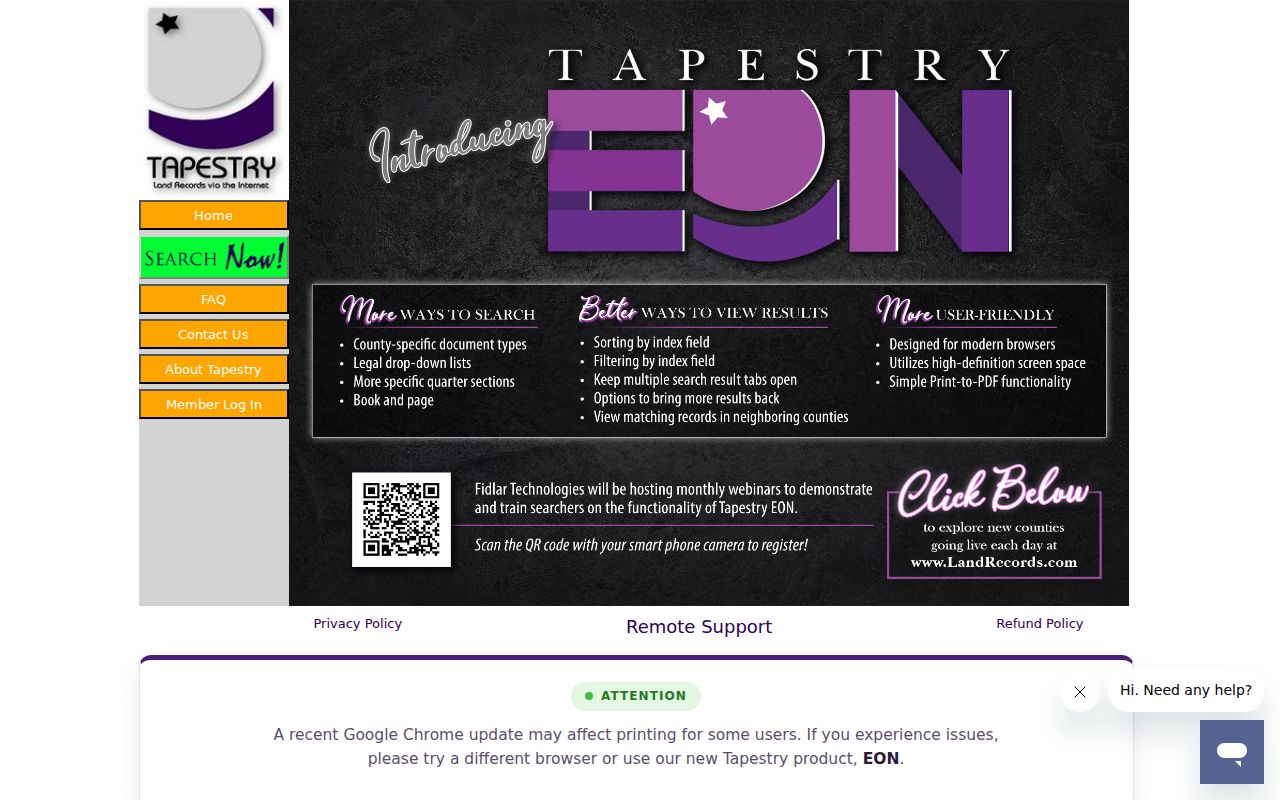
That screen is only a gateway. Party fields, date ranges, and instrument images still need checking against the Whitley County Recorder's index.
Note: Save every instrument number and book-page reference before leaving a paid result so the same deed can be retrieved again.
Follow Whitley's Grantor-Grantee Chain
A chain of title is the ordered run of instruments. It links one owner to the next. Start from the current assessment owner. Do not assume the parcel card reflects the newest transfer. The deed index is built around parties. The grantee receives an interest. The grantor transfers one. Book-page citations point to older bound volumes. Instrument numbers identify later filings in the Whitley County deed records.
- Find the present owner on Beacon, then search that name as grantee near the likely purchase period.
- Open the newest plausible deed. Match its legal description, parcel clues, and prior reference to the subject land.
- Record the grantor, grantee, date, deed type, instrument number, and any book-page reference.
- Search the named grantor as a grantee in an earlier period. Repeat the match against the same land description.
- Check corrective deeds, affidavits, survivorship papers, mortgages, releases, easements, and plats between transfers.
- When the chain crosses 1973, continue through the office's reverse index, deed books, and microfilm.
- Grantor
- The party that transfers the stated interest.
- Grantee
- The party that receives the stated interest.
- Chain of title
- The linked sequence of recorded ownership instruments for the same land.
- Book and page
- A citation to the bound or imaged volume where an older instrument appears.
- Instrument number
- The unique filing reference assigned to a recorded document.
Estate and Corrective Transfers
Deed chains in Whitley County rarely run in a straight line. A transfer can surface as a personal representative's deed, trustee deed, survivorship filing, life-estate instrument, affidavit, or corrective deed within Whitley County deed records. Estates often appear as temporary grantors. Trusts get indexed under the trustee, the trust name, or both. Read the signature and capacity lines closely. When a transfer depends on an estate order, connect the filing back to probate. That link tells you who could lawfully sign.
The Recorder index states a transfer without narrating it. Whitley County Clerk files fill in that story. Estate records run from 1838 to 2007 in the Clerk's published series, with later case material in current systems. When a deed names an estate or personal representative, pull the party's official court file as a cross-check. The recorded conveyance itself still controls.
Mortgages Around Whitley Deeds
Ownership and debt leave separate tracks. A deed moves the stated interest. A mortgage secures debt against it. Assignments can move that mortgage between holders, and a later release may clear the recorded lien. Search both parties plus the original instrument reference. A discharge tied to a different parcel does not clear the subject land, even when the name matches.
Other instruments gather around a deed chain. Judgments, mechanic's liens, tax liens, lis pendens, and easements can appear in the Recorder index too. A foreclosure action may carry a separate file in Whitley Circuit or Superior Court through Indiana MyCase. The Clerk's official file controls. Keep court events, recorded notices, sheriff-sale papers, and the deed that followed as separate entries in your chronology.
Historic Whitley Land Books
Whitley County dates to 1835. Its oldest chains live in handwritten books, grantor-grantee indexes, tax rolls, survey notes, plats, and probate packets. The Indiana State Library's Whitley County guide points to an 1862 landowner index, will abstracts from 1839 through 1913, naturalization records, and other microfilm. These sources suggest names and time periods. A landowner index, though, is not the deed itself.
Historic maps add place clues. Columbia City Sanborn maps begin as early as 1886, while Churubusco runs begin as early as 1892. State Library holdings include Whitley plat books for 2003, 2011, 2013, and 2023. Use an addition name, old street, lot and block, or township section from those sources to re-enter the Recorder chain. When no digital image exists, switch media.
Order a Whitley County Deed
Pick the copy channel once you know the exact filing. Tapestry includes the viewed image in its search fee and charges $1 per printed page. Laredo subscribers can retrieve available images within their plan. For office help, give the Recorder the grantor and grantee names, a date range, the deed type, the legal-description clue, and the instrument or book-page citation. A precise request beats asking staff to trace a full ownership history.
The Recorder's office supplies the recorded copy. Ask what form you need. Some uses require certification. Indiana APRA generally allows inspection and copying of public records during regular hours, subject to statutory exceptions and reasonable production time. It does not require the office to build a new title report. Older deed records may come from books or microfilm at the counter. The current portal is not the only route.
Recorded is not guaranteed. The Whitley index shows what reached the Recorder. It does not resolve unrecorded interests, prove a boundary, or give a title opinion.