
Fields in Whitley Tax Records
Three systems share the work. Beacon adds parcel and assessment context, while the county tax search shows bills and payments. Indiana Gateway gives a statewide view built from county-reported data. Check the field label and year before comparing figures.
| Field | What it shows | Where it appears |
|---|---|---|
| Parcel and taxpayer label | Connects the account to the assessed tract and billed name | Beacon, LowTaxInfo, Gateway |
| Assessed value | Value carried into Indiana's tax process for the stated year | Assessor record and Form 11 |
| Taxing district | Local district tied to the parcel's situs | Auditor record and bill |
| Deductions | Approved reductions affecting taxable value | Assessor and Auditor |
| Charges and adjustments | Parts included in the account total | LowTaxInfo detail |
| Payments and balance | Posted collections and what remains due | Treasurer tax record |
Assessed value is not the tax. It is not a sale price either. Deductions can shrink the taxable base. The district and its approved rates then shape the final bill. A balance may fold in charges, fees, adjustments, and payments. Keep each source label rather than blending everything into one "property value" figure.
The parcel number deserves the same care. Owner labels and street forms change over time. Still, the key ties the account to Beacon, the Auditor's roll, and later Whitley County property tax records.
January 1 Whitley Assessments
Indiana sets January 1 as its assessment date. The Whitley County Assessor weighs cost, income, and sales comparisons to find market-value-in-use. The office also runs annual adjustment. This trending draws on county sales. A value can move without a new deed or arm's-length sale.
Public data may lag, since a fresh transfer can reach the deed index before the assessment owner or mailing record catches up. Note the retrieval date and call Assessor Kim Erdly's office at 260-248-3109 when timing affects an assessment review.
Whitley Property Tax Search Fields
The county steers local lookups to LowTaxInfo, with Indiana Gateway as a second public route. LowTaxInfo accepts an optional name, address, parcel number, or numeric duplicate number. Gateway demands pay year and county before added filters. A parcel may need its formatted or unformatted key.
| Search key | Portal | Use |
|---|---|---|
| Name | LowTaxInfo or Gateway | Find accounts, then verify the parcel |
| Address | LowTaxInfo or Gateway | Start with a known situs and street variants |
| Parcel number | Both | Match the same tract shown in Beacon |
| Duplicate number | LowTaxInfo | Retrieve an account by its billing key |
| Pay year and county | Gateway | Required base filters |
| District, rate, bill range | Gateway | Narrow and sort results |
Gateway's data comes from the counties, including Whitley County, and a formatting error may need the Auditor to correct it. When a total looks unclear, check both views. The local account remains the source for billing details.
Read a Whitley Tax Bill
Start with the parcel, not the total. Both records should name the same tract. Then compare assessment year, pay year, district, taxpayer label, installments, charges, payments, adjustments, and balance before drawing any conclusion.
- Find the parcel in Beacon and save its full key, situs, owner label, and district.
- Open Indiana Gateway or LowTaxInfo. Select Whitley County and the right pay year.
- Search by address or parcel and match the result to the property, not just the taxpayer name.
- Read each installment, charge, adjustment, payment, balance, and posting date.
- Compare values and deductions with the Assessor or Auditor record.
- Ask the Treasurer about collection and the Auditor about county-reported account corrections.
- Assessed value
- The value carried into the tax process for the stated assessment year.
- Market-value-in-use
- Indiana's standard based on how property is used in its market.
- Taxing district
- The local unit combination applied to the parcel.
- Homestead deduction
- An approved reduction for qualifying property, not broad proof of residence.
- Tax lien
- A government claim that arises from unpaid property tax.
The captured Gateway tax lookup shows the entry screen for county-reported bills.
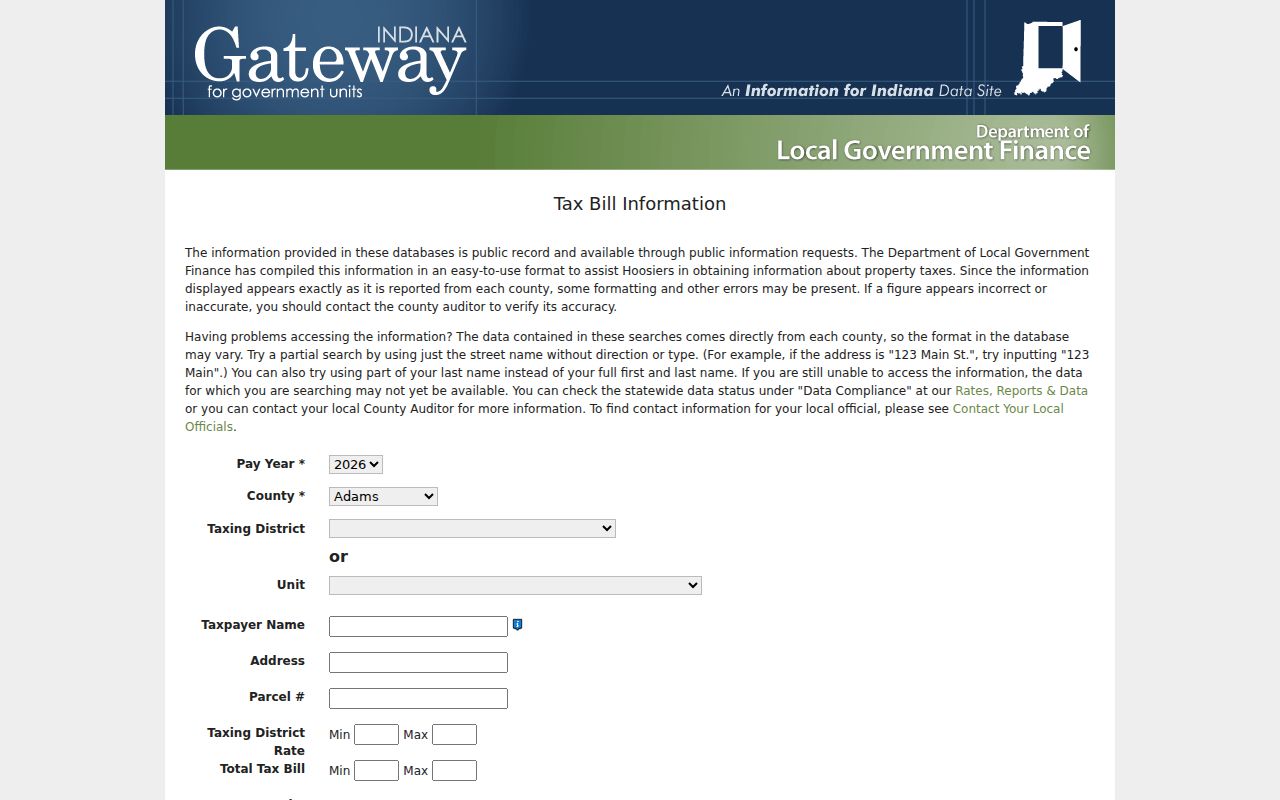
Pick the proper pay year first. Another year's result can be accurate yet still answer the wrong tax question.
Whitley Tax District Keys
In Whitley County, the last three digits of a parcel ID can carry the taxing district. This applies when they are preceded by 92. A local ending of 001 maps to 92001. The shortcut ties the parcel key to the tax roll. Yet the district printed on the current record still governs.
March 1 fixes the situs that sets the taxing district. The mailing city, ZIP, township, or incorporated boundary can all differ from it. Rural routes and parcels near town limits show this often. Splits, replats, and annexations happen too. So trust the district shown on the record itself.
Note: A postal city is only a delivery label, while Whitley County's taxing district follows the parcel's recorded local situs.
Deductions in Whitley Records
The Assessor and Auditor coordinate values, deductions, sales disclosures, and the tax roll. An approved deduction trims the taxable amount. It leaves the deed consideration and the land unchanged. Check the deduction name, year, and parcel. Eligibility questions go to county offices, not search vendors. Auditor Tiffany Deakins sits at 220 W Van Buren Street in Columbia City, reachable at 260-248-3100. The Assessor works from Suite 202 in the same government center. Bring the parcel key and notice year so staff can find the right account.
Whitley's Current Value Cycle
The DLGF Whitley County page gathers ratio studies, assessed-value data, sales disclosures, tax bills, deductions, Form 11 material, and appeal resources. The 2025 ratio narrative flags cyclical reassessment work in Columbia, Etna Troy, Jefferson, Richland, Smith, and Thorncreek townships. It names January 1, 2025 the effective land-order date. One small industrial-property class gets its own trending adjustment.
The statewide 2026 through 2030 cycle begins in 2026. Plans call for inspecting about one quarter of parcels each year. Annual trending continues. A change can stem from inspection, corrected characteristics, land-order work, or market-value adjustment. It is not proof of a sale.
The DLGF county resource is the state entry point for Whitley assessment documents.
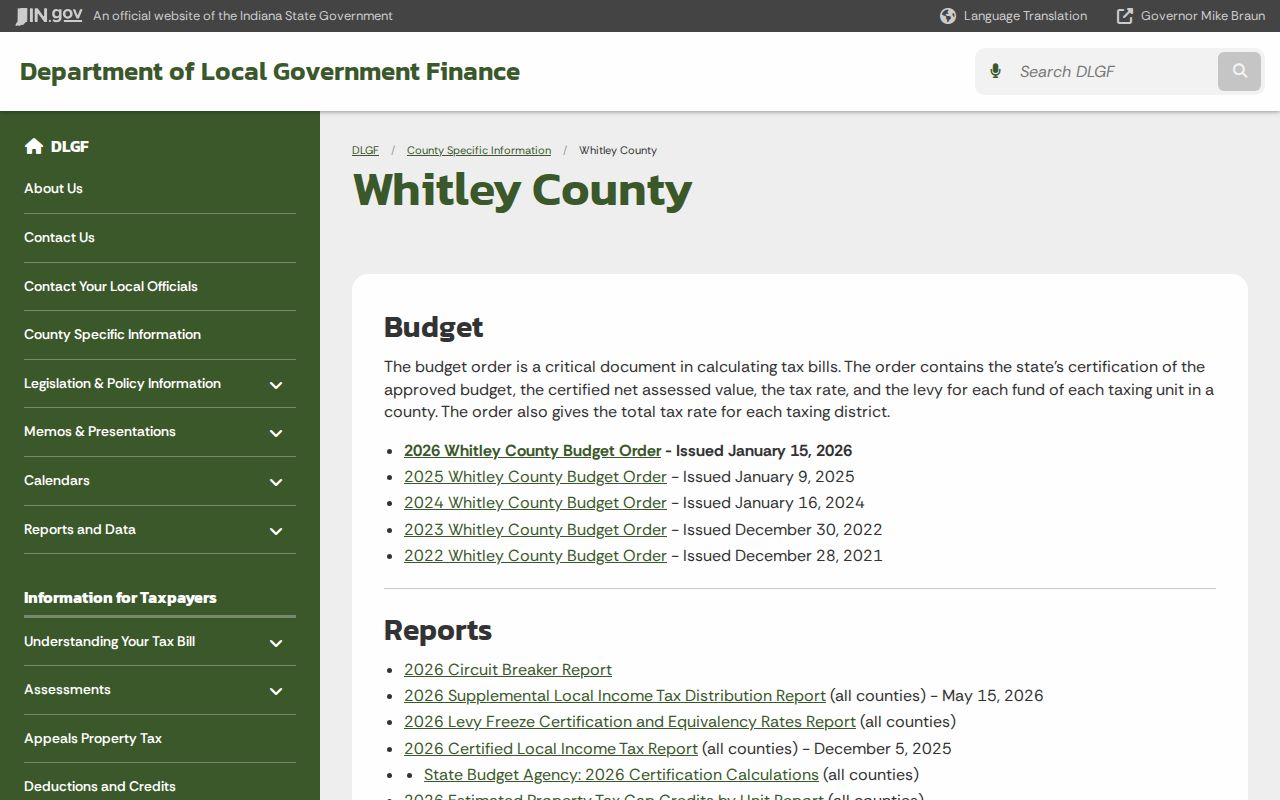
Match the dated report to the assessment year at hand.
Whitley Delinquency and Tax Sale
Treasurer Kay Gatton's office manages the tax roll end to end. It handles annual bills and payments, delinquency, and tax-sale status. At the counter, the office takes cash, check, or money order. Credit cards are not accepted in person. A mailed payment counts if it is postmarked by the due date. Remote card payments run through Official Payments, jurisdiction code 2467, and carry a fee.
For tax-sale matters, the county links to SRI. A 2023 official notice spells out certified parcels, bidding, redemption, notice, and surplus rules. Those terms governed that one sale only. Always pull the current notice before relying on any of it. Delinquency alone tells you little. It does not prove foreclosure, vacancy, abandonment, or a completed transfer. Verify later payments, redemption, sale records, and any court papers. Then check for the resulting Recorder deed.
Keep each tax-sale stage separate in your property search. Certification names the parcels carried into a sale process. Registration and bidding attach to the scheduled auction. Redemption can still change the outcome after the sale event. A deed, by contrast, is a later recorded instrument. You should never infer one from a bidder list. Search the exact parcel through every stage and date what you find.
Payment rules also track a specific billing cycle. The Treasurer takes cash, check, or money order in person but no counter credit card. Mailed payments need a postmark by the due date. A receipt request should include a self-addressed stamped envelope. Card payments by phone use Official Payments at 1-877-690-3729, jurisdiction code 2467, with a fee. The May 12 and November 10 dates were posted for 2024 pay-2025 bills. Treat them as historical dates, not a standing calendar for later years.
Appeal a Whitley Assessment
The Assessor sends Form 11 assessment notices. Whitley County sets an April 30 statutory mailing date. A June 15 appeal deadline applies when the notice goes out on time. The actual notice controls, so read its date and instructions closely. Build the appeal from the parcel's characteristics and its land record. Add comparable sales and any clear error in class, acreage, structures, or use.
An appeal contests valuation facts. It will not change a deed owner of record. It cannot settle a boundary dispute or fix a payment posting. Title questions belong with the Recorder. Boundary and geometry issues go to the Surveyor or the plat. Payment questions go to the Treasurer. Keep dated copies of everything you file.
Solid evidence speaks to the assessed property and the assessed year. Compare the parcel's land and improvement characteristics, classification, acreage, use, and relevant market data. Bundle the Form 11 mailing date, the appealed value, your requested correction, and each supporting document. For a split or combined parcel, include both the old and new keys. If Beacon and the notice disagree, preserve both records. Ask the Assessor which roll entry controls the appeal.
Watch the notice date. When Form 11 is timely mailed, Whitley County identifies June 15 as the appeal deadline. Confirm current instructions before filing.